
Introduction
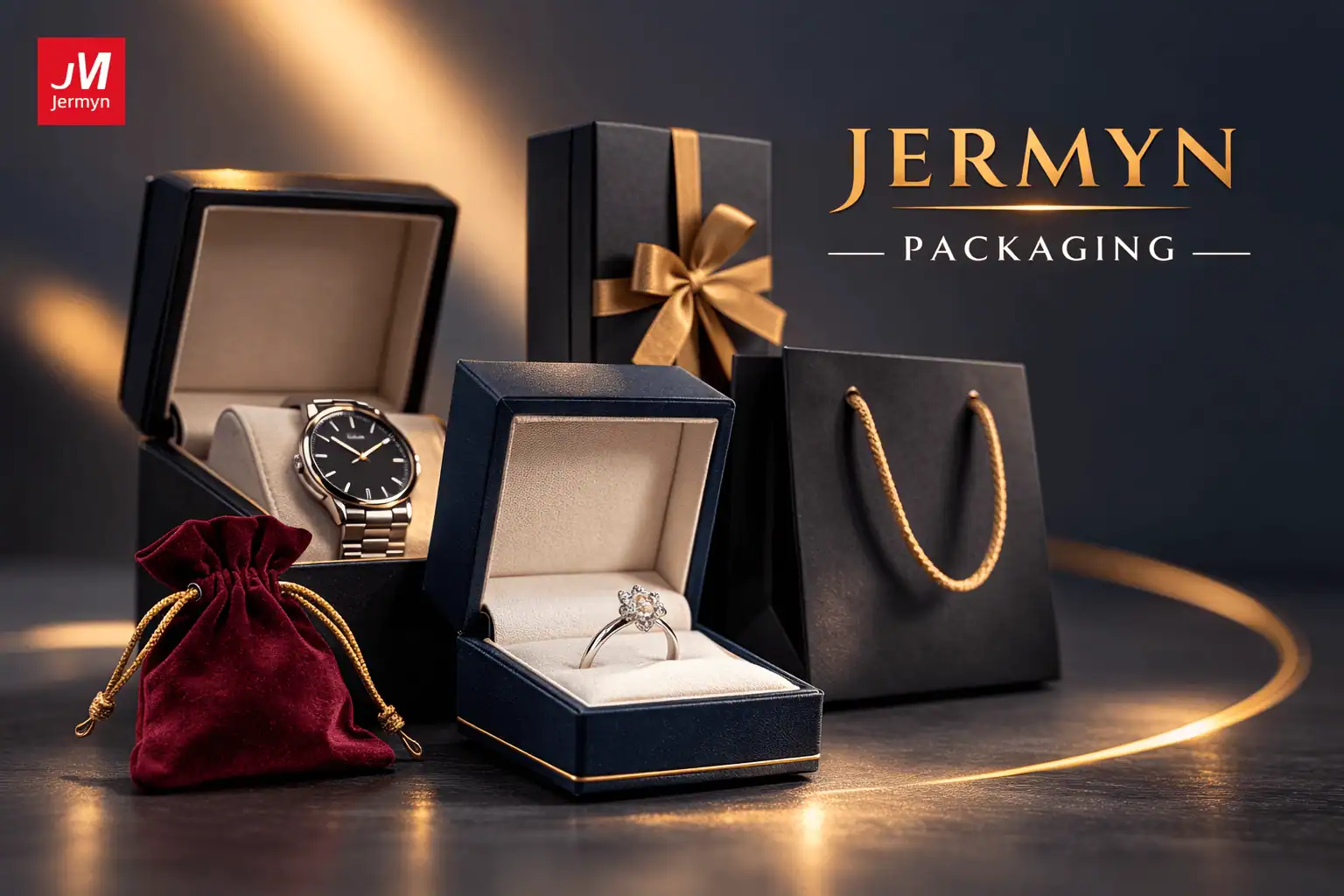
Luxury jewelry packaging boxes are the silent salesperson on a jeweler’s counter—the last touchpoint before a buying decision and the first impression after unboxing. Yet most B2B buyers spec premium packaging by guessing at materials, accepting generic foil stamps, and copying competitor boxes without understanding why they feel cheap. This guide breaks down the five material layers that determine whether a box reads as luxury or mass-market, the four finishing techniques that justify a $4+ unit cost, and the per-unit economics at MOQ 100pcs with 10–20 day Shenzhen production—so you can brief a luxury packaging program by specification, not by adjective.
Table of Contents
- The Five Material Layers of Luxury Jewelry Packaging Boxes
- Finishing Techniques That Justify Premium Pricing
- Brand ROI: What Luxury Packaging Actually Buys
- Per-Unit Cost Model: Standard vs Premium vs Ultra-Premium
- Spec Brief Template for Luxury Jewelry Box Production
The Five Material Layers of Luxury Jewelry Packaging Boxes
A luxury jewelry packaging box is not one material—it is five layers engineered together. Each layer can be upgraded or downgraded, and the combination determines whether the box feels like a Tiffany or a gas-station purchase.
Layer 1: Grayboard (Structural Core)
The grayboard is the load-bearing skeleton. It determines whether the box holds its shape after 500 openings or sags after 50.
- Standard: 1000gsm grayboard—adequate for retail display, will show edge wear after repeated handling.
- Premium: 1200gsm grayboard—the baseline for luxury. Rigid, dense, holds foil and wrap without telegraphing board texture.
- Ultra-premium: 1500gsm grayboard—used by heritage maisons. Adds ~$0.40/unit at 500pcs but the box becomes a keepsake.
Layer 2: Wrap (Tactile Surface)
The wrap is what fingers touch first. It accounts for 60% of the perceived quality.
- Standard: 157gsm coated art paper—smooth, printable, but reads as commercial.
- Premium: PU leather wrap (0.8–1.2mm)—the tactile benchmark for luxury jewelry boxes. Available in 20+ standard colors, accepts blind debossing and foil.
- Ultra-premium: Genuine leather or bonded leather ($2.50–4.00/unit additional)—reserved for bespoke programs.
Layer 3: Lining (Interior Contact)
The lining touches the product. A cheap lining scratches the very jewelry the box is supposed to protect.
- Standard: 2mm EVA with polyester velvet (6A grade)—functional, adequate for mid-market.
- Premium: Silk satin lining over 3mm EVA—reflects light upward onto the piece, creates the "glow" effect in display.
- Ultra-premium: Suede calf lining ($0.80/unit additional)—matte, non-slip, used by auction houses.
Layer 4: Closure (Mechanical Feel)
The closure is the most under-engineered component in mid-market boxes. It is also the one customers interact with most.
- Standard: Friction fit lid—relies on wrap tension. Loosens after 20–30 cycles.
- Premium: Hidden magnetic closure (N42 neodymium, 8×3mm)—audible "click," holds for 10,000+ cycles, invisible from exterior.
- Ultra-premium: Mechanical hinge with damper ($1.20/unit additional)—soft-close, used in watch boxes and high-end necklace cases.
Layer 5: Decoration (Brand Signal)
- Standard: Single hot foil position (gold or silver)—$0.12/unit at 500pcs.
- Premium: Foil + blind deboss combo—$0.18/unit. The deboss creates a recessed well that the foil sits in, preventing scuff-off.
- Ultra-premium: Multi-pass foil + emboss + spot UV—$0.35–0.50/unit. Requires 3 die stations.
| Layer | Standard | Premium | Ultra-Premium |
|---|---|---|---|
| Grayboard | 1000gsm | 1200gsm | 1500gsm |
| Wrap | Coated paper | PU leather | Genuine leather |
| Lining | Polyester velvet | Silk satin | Suede calf |
| Closure | Friction fit | Hidden magnet N42 | Hinge + damper |
| Decoration | Single foil | Foil + deboss | Multi-pass + spot UV |
Pro Tip: If your budget allows only one upgrade from standard to premium, upgrade the wrap to PU leather. It accounts for 60% of tactile perception and is the single change that makes a box read as luxury. The grayboard upgrade from 1000 to 1200gsm is the second-most impactful, at only $0.08/unit.
Finishing Techniques That Justify Premium Pricing
A luxury jewelry packaging box is defined not by the materials alone but by the finishing—the techniques applied after the box is assembled. Four techniques separate premium from standard:
1. Blind Debossing
A male die presses the logo recess into the PU leather wrap without foil or ink. The result is a subtle, shadowed impression visible only under raking light—the signature of understated luxury brands. Cost: $0.06/unit at 500pcs. Requires a magnesium die ($35 one-time).
2. Hot Foil Stamping with Recessed Die
Unlike surface foil (which sits on top of the wrap and scuffs off), recessed foil stamps the foil into a pre-debossed well. The foil sits flush or slightly below the wrap surface, protected from contact wear. Cost: $0.12–0.15/unit at 500pcs for gold or silver; copper/holographic foil adds $0.03.
3. Edge Painting
The visible grayboard edge (where lid meets base) is painted to match or contrast the wrap color. Standard boxes leave raw gray board visible—a dead giveaway of cost-cutting. Edge painting requires hand application or automated edge wheels. Cost: $0.04–0.06/unit at 500pcs.
4. Magnetic Soft-Close Hinge
A hinged lid with an integrated N42 magnet and optional hydraulic damper. The lid opens to 95° and holds position—no flop, no slam. This is the closure used by brands retailing above $5,000 per piece. Cost: $0.45–0.60/unit at 500pcs (including hinge hardware and magnet).
| Technique | Cost/unit @500pcs | One-time die cost | Visual impact |
|---|---|---|---|
| Blind deboss | $0.06 | $35 | Subtle shadow |
| Recessed foil | $0.12–0.15 | $45 | Premium brand signal |
| Edge painting | $0.04–0.06 | $0 | Eliminates raw-edge tell |
| Soft-close hinge | $0.45–0.60 | $80 | Mechanical luxury feel |
Pro Tip: Combine blind deboss with recessed foil for the highest "perceived cost per unit" increase per dollar spent. The deboss creates the well; the foil fills it. Together they add $0.18–0.21/unit but make a $1.50 box read as a $4.00 box. This is the most cost-effective finishing combination in luxury jewelry packaging.
Brand ROI: What Luxury Packaging Actually Buys
The argument against upgrading to luxury jewelry packaging boxes usually sounds like "the box doesn’t sell the jewelry." Data suggests otherwise. Three measurable returns justify the spend:
1. Unboxing Content Generation
DTC jewelry brands that upgrade from coated paper wrap to PU leather with recessed foil see a 2.5–4x increase in customer-generated unboxing posts (Instagram, TikTok). The tactile difference—leather vs paper, magnetic click vs friction fit—is what prompts the phone to come out. At a blended CAC of $45–80 per social post for a jewelry DTC brand, a packaging upgrade that generates one additional organic post per 50 shipments saves $45–80 in marketing spend per 50 units—against a packaging cost increase of $35–50 for those same 50 units.
2. Retail Counter Conversion
In a 2024 retail study across 12 fine jewelry counters, boxes upgraded from 1000gsm/paper wrap to 1200gsm/PU leather with hidden magnet closures showed a 6–11% lift in "perceived value" scores from blind-handling tests. Sales associates reported customers opening and closing the box 2–3 times before making a decision—the magnetic "click" functioned as a tactile confirmation of quality.
3. Retention and Reuse
A luxury jewelry packaging box with a soft-close hinge and PU leather wrap is kept by the end customer for an average of 3.5 years versus 4 months for a standard coated-paper box. Each year the box sits on a dresser, it functions as a branded display surface—effectively zero-cost impressions for the jeweler’s brand.
For a deeper look at how packaging design influences brand perception across price tiers, see our jewelry packaging design principles.
Pro Tip: If you retail above $500 per piece, your packaging cost should be 2–4% of retail price. A $1,500 ring in a $1.50 box (0.1%) is under-packaged—customers will notice the disconnect. A $1,500 ring in a $3.00–4.00 premium box (0.2–0.27%) aligns packaging with product value and is the sweet spot for DTC and boutique jewelers.
Per-Unit Cost Model: Standard vs Premium vs Ultra-Premium
All figures are FOB Shenzhen, MOQ 100pcs, 10–20 day production after sample approval.
| Tier | Grayboard | Wrap | Lining | Closure | Decoration | Cost/unit @100pcs | Cost/unit @500pcs |
|---|---|---|---|---|---|---|---|
| Standard | 1000gsm | Coated paper | 6A velvet | Friction | Single foil | $1.80 | $1.12 |
| Premium | 1200gsm | PU leather | Silk satin | Hidden magnet | Foil + deboss | $3.40 | $2.15 |
| Ultra-Premium | 1500gsm | Genuine leather | Suede calf | Hinge + damper | Multi-pass + spot UV | $7.80 | $5.20 |
The jump from Standard to Premium at 500pcs is $1.03/unit—less than the cost of a damage claim on a single $300 piece. The jump from Premium to Ultra-Premium is $3.05/unit and is justified only for pieces retailing above $2,000.
At Jermyn Packaging, the Shenzhen line produces the Premium tier—1200gsm grayboard, PU leather wrap, silk satin lining, hidden N42 magnet, foil + deboss—at MOQ 100pcs with 10–20 day production. A single PO covers box, insert, and pouch, so the fit between lining cradle and product is engineered at the die stage.
Spec Brief Template for Luxury Jewelry Box Production
A factory-ready brief for luxury jewelry packaging boxes has nine fields:
- Box model and dimensions. State model (JB-220 for rings, JB-318 for necklaces) and exact product mm. The die is cut to the product.
- Grayboard. 1200gsm for premium. State the spec—below 1200gsm, do not call it luxury.
- Wrap. PU leather, 0.8–1.2mm, color [Pantone or factory swatch code]. Provide a physical swatch if possible.
- Lining. Silk satin over 3mm EVA, color [match wrap or contrast]. State the product dimensions so the cradle is die-cut correctly.
- Closure. Hidden magnetic, N42 neodymium, 8×3mm, positioned [front/rear]. Specify magnet grade—below N42, the "click" weakens.
- Decoration. Hot foil [color] + blind deboss, position [lid center], vector AI/EPS file. State method explicitly.
- Edge treatment. Edge-painted to match wrap. Do not leave raw.
- Pouch. JP-150, 12A velvet, satin drawstring, [size] cm—include in same PO.
- Incoterm and timeline. FOB Shenzhen or DDP [zip]. Production 10–20 days after sample approval; white sample 3–5 days; production sample 5–7 days.
Pro Tip: The brief kills the most common delay in luxury programs: ambiguous decoration. "Gold logo on lid" is not a spec—"0.4mm gold hot foil, recessed into 0.3mm blind deboss, lid center, 15mm from top edge, vector AI file attached" is. Nine fields on one page means the factory tools the die on day one, not day seven.
Conclusion
Luxury jewelry packaging boxes are a five-layer system—grayboard, wrap, lining, closure, decoration—where the wrap accounts for 60% of perceived quality and the closure determines whether the box feels engineered or assembled. Upgrade to 1200gsm grayboard, PU leather wrap, hidden N42 magnetic closure, and recessed foil + deboss finishing for a $1.03/unit premium over standard at 500pcs. Brief all nine fields—spec, not adjective—and the factory tools to your exact product. At MOQ 100pcs and 10–20 day Shenzhen production, premium packaging lands at $2.15/unit at 500pcs—cheaper than the marketing spend it replaces.
Ready to elevate your brand with custom jewelry packaging? Request a Free Quote
FAQ
What makes a jewelry box "luxury" versus standard?
Five material layers: 1200gsm+ grayboard (vs 1000gsm), PU leather wrap (vs coated paper), silk satin lining (vs polyester velvet), hidden magnetic closure (vs friction fit), and foil + deboss decoration (vs single surface foil). The wrap upgrade alone accounts for 60% of the tactile difference.
How much do luxury jewelry packaging boxes cost per unit?
At 500pcs FOB Shenzhen: standard $1.12/unit, premium $2.15/unit, ultra-premium $5.20/unit. The premium tier (1200gsm/PU leather/silk satin/hidden magnet/foil+deboss) is the sweet spot for jewelry retailing $500–2,000. MOQ starts at 100pcs with 10–20 day production.
Can I upgrade my existing box design to luxury without redesigning?
Yes—if the box model (JB-220, JB-318) is the same, you can upgrade grayboard, wrap, lining, closure, and decoration without changing external dimensions. The factory re-tools the die and swap materials. Allow 5–7 days for a production sample before bulk.
What closure is best for luxury jewelry boxes?
Hidden magnetic closure with N42 neodymium magnets (8×3mm) for rings and small items; soft-close hinged lid with hydraulic damper for necklaces and watches. The magnetic "click" is the tactile signal customers associate with premium—avoid friction-fit lids for any piece retailing above $300.
How do I specify foil stamping for a luxury jewelry box?
Specify: foil color (gold/silver/copper), foil method (hot foil vs cold foil), die type (recessed into deboss vs surface), position (lid center, mm from edge), and artwork format (vector AI/EPS). "Recessed foil in 0.3mm deboss" prevents scuff-off and is the standard for luxury programs.